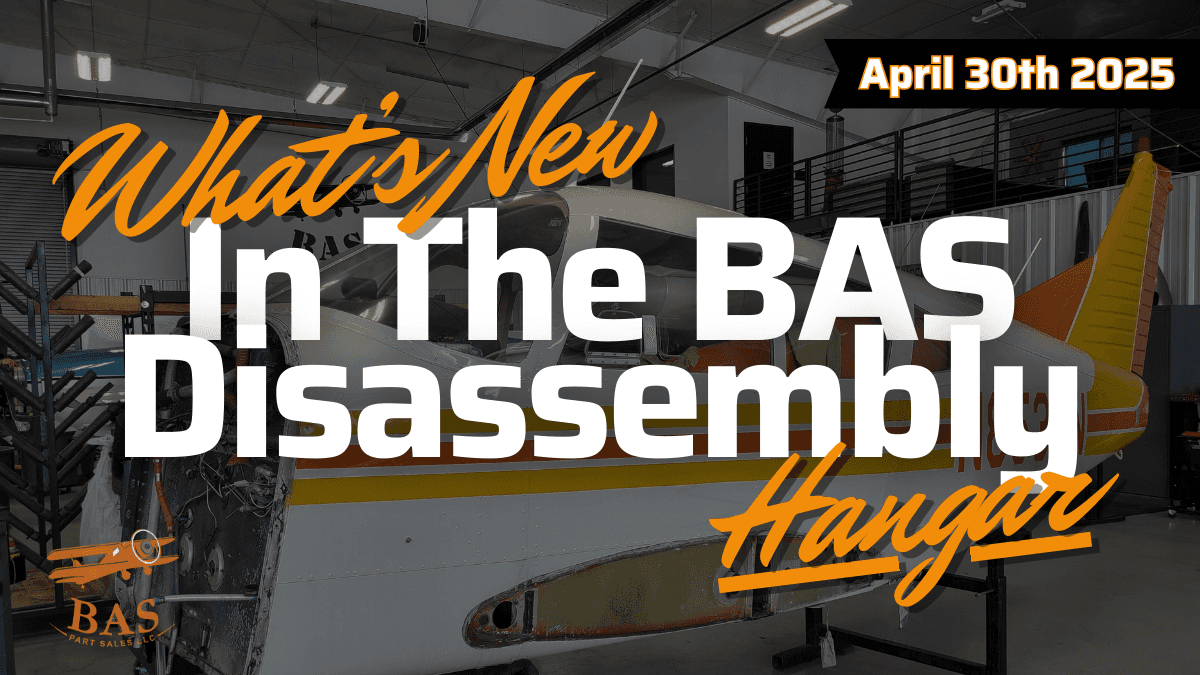

New In The BAS Disassembly Hangar May 28, 2025
Posted by Clinton McJenkin on May 28th 2025

After a rare moment of silence in the hangar last week—when we stripped out the old epoxy and laid down a brand-new, high-gloss finish—the wrenches are officially spinning again. The crew is back in action, and we’re hitting the throttle.
On the teardown ramp this week: a King Air B90, Piper Malibu Mirage, Piper Navajo C/R, and a Beechcraft Bonanza. These aren’t just airframes—they’re packed with high-demand parts ready for dispatch, from turboprop gear and clean cabin systems to flight controls and avionics.
The floor might be spotless, but it won’t stay that way for long. Inventory’s moving fast, and the shop’s racing to keep up.
Need components? Taxi over to our sales team now—before these parts climb out of stock.
Have a question? Need pictures? Need a part? Need more information or assistance shipping an item? Get in touch...
Call: 970-313-4823
Email: Sales@Baspartsales.Com
Chat: Online or in the BAS Mobile App

Get the Jump - Right from Your Pocket
Want first dibs on rare and high-demand parts the second they hit the teardown floor? Download the BAS Mobile App and stay ahead of the pack. App users get early alerts on fresh inventory - engines, avionics, interiors, and more - before the rest of the field even knows it’s landed.
No waiting. No guesswork. Just real-time notifications straight from the disassembly hangar to your phone.
Don’t fall behind - download the app now and take off with the edge.


Beechcraft King Air B90
The Beechcraft King Air stands as one of the most iconic and enduring twin-turboprop aircraft families in aviation history. First taking flight in 1963 and officially entering service in 1964, the King Air series was developed from the Queen Air platform and quickly set the standard for executive and utility aircraft. It was the first aircraft of its class and remained in continuous production for over 57 years, a testament to its versatility, reliability, and market appeal. The King Air family was initially split into two major branches: the Model 90 and 100 series, which retained a more conventional tail design, and the later 200 and 300 series, which featured a distinctive T-tail and were originally marketed as the "Super King Air" before Beechcraft dropped the prefix in 1996.
With more than 3,300 units built, the King Air outpaced all competitors in its category, finding extensive use not only in corporate and civil aviation but also among military operators worldwide. Its enduring success is credited to continual updates in avionics, engines, and cabin comfort, which kept the design relevant even in the face of emerging turboprops and light jets like the Pilatus PC-12 and Embraer Phenom 100. The King Air 90 series in particular evolved through numerous refinements—from the original Model 65-90 to the sophisticated C90GTx—before production concluded in 2021.
Introduced in 1968, the Model B90 represented a significant refinement over its predecessors, the 65-90 and A90 models. It incorporated improved pressurization, a larger wingspan, upgraded ailerons for better handling, and more modernized avionics. It also featured a higher Maximum Take-Off Weight (MTOW) of 9,650 lbs and was powered by twin Pratt & Whitney PT6A-20 engines producing 550 shp each. One of its distinguishing design elements was the addition of an extra side window, enhancing both aesthetics and interior light.
A total of 184 B90 units were built before production transitioned to the improved C90 model in 1971. Notably, the B90’s versatility was recognized by the U.S. military, where a modified version served as VC-6A—famously used by President Lyndon B. Johnson as a personal transport aircraft with the “Air Force One” callsign when he was aboard. The B90 remains appreciated in aviation circles for its blend of rugged reliability and executive-class performance.
This airplane was set up for skydivers. So we don't have a complete interior, but we do have a nifty roll-up door, platform, and accessories with all on one STC. One of the engines was the downfall of this bird, and they are available, along with the props. Except for the interior, this airplane is complete and we will have all of the airframe, landing gear, avionics, and other system components available.


Piper PA-31-325 Navajo C/R
The Piper PA-31 Navajo is a versatile twin-engine, low-wing utility aircraft developed by Piper Aircraft, intended to serve both corporate and small airline markets. The design process began in 1962 under the internal project name Inca, prompted by founder William T. Piper’s vision for a six- to eight-seat commuter aircraft. Drawing visual cues from the PA-30 Twin Comanche, the PA-31 flew for the first time on September 30, 1964. It officially entered service after FAA certification on February 24, 1966, with deliveries commencing in 1967. Featuring two 310 hp Lycoming TIO-540-A turbocharged engines encased in distinctive “tiger shark” cowlings, the aircraft offered a blend of speed, performance, and cabin comfort that made it appealing for a wide range of operators.
As the model matured, several upgrades and variants were introduced. Key improvements included increased maximum takeoff weight, enhanced cabin design with additional windows, and eventually the development of pressurized and stretched versions like the PA-31P and PA-31-350 Chieftain. Piper also responded to different market needs by optimizing certain variants for specific roles—such as the T1020 commuter airliner and the turboprop-powered T1040. Over its production run from 1967 to 1984, Piper built nearly 4,000 units. The PA-31 family became a mainstay for air charter companies, commuter airlines, and corporate fleets across multiple countries, and was even assembled under license in South America.
The PA-31-325 Navajo—also known as the Navajo C/R for its Counter-Rotating engine configuration—was introduced in 1974 as a refined derivative of the Navajo B model. It featured counter-rotating Lycoming TIO-540 and LTIO-540 engines, each rated at 325 hp. This configuration, borrowed from the larger PA-31-350 Chieftain, significantly improved handling by eliminating the critical engine scenario during single-engine operations. Certified in May 1974, the PA-31-325 entered production for the 1975 model year, offering enhanced flight safety and balanced performance. It represented a thoughtful engineering step forward, combining robust power with improved operational confidence for pilots and operators alike.
This aircraft was hurt enough during an accident while in maintenance to lead it to us. The cost of repairs exceeds the good sense of the investment required, so we're parting it out. We expect to recover nearly everything from this airplane, including...
• And much, much, much more!


Beechcraft S35 Bonanza
The Beechcraft Bonanza, introduced in 1947 by Beech Aircraft Corporation of Wichita, Kansas, stands as one of the most iconic and enduring aircraft in general aviation history. Designed by Ralph Harmon and his team, the Bonanza was a radical departure from the wood-and-fabric light aircraft of the time. Its sleek, all-metal construction, retractable tricycle landing gear, and signature V-tail gave it both advanced performance and futuristic styling. Its first flight occurred on December 22, 1945, and production began in 1947. Impressively, the Bonanza remains in production to this day, making it the longest continuously produced aircraft in history.
Throughout its production run, the Bonanza family evolved into several major variants, including the original V-tail Model 35, the conventional-tailed Model 33 (Debonair), and the stretched fuselage Model 36. Despite the prestige associated with the V-tail design, it also attracted a reputation for in-flight structural failures and challenging flight characteristics, often linked to inexperienced or overconfident pilots. Nonetheless, rigorous FAA testing and design modifications—including airworthiness directives to reinforce the tail structure—have kept the aircraft in active service. The Bonanza's blend of innovation, performance, and longevity has secured its place in aviation lore.
The S35 Bonanza, produced from 1964 to 1966, is a notable member of the Model 35 V-tail series. It marked a significant upgrade over its predecessors, featuring a powerful 285 hp Continental IO-520-B engine, which gave it improved performance characteristics. The aircraft also included a longer cabin interior and was the first V-tail variant to offer optional fifth and sixth seats, enhancing its utility for family or business travel. Additionally, it featured a redesigned rear window for improved visibility and aesthetics. A total of 667 units were built, making it one of the more prolific variants of the V-tail Bonanza line.
The S35 represents a balance point in the evolution of the Bonanza—offering a potent mix of speed, power, and practicality—while still retaining the aircraft’s distinctive V-tail profile that made the Bonanza an icon. Its design improvements addressed both comfort and operational capability, making it a favored choice among serious aviators during its production window.
A strong storm, with hurricane-force winds, caused the hangar to collapse on this aircraft. It took some surface damage, leading it to BAS for disassembly. We will recover some outstanding Bonanza parts and components, such as...
• And much more


Piper PA-46-350P Malibu Mirage
The Piper PA-46, now known as the Piper M-Class, is a family of American light aircraft that has been in continuous production since 1979. Initially introduced to compete with the Cessna P210 Centurion, the PA-46 was designed as a high-performance, pressurized, single-engine aircraft with seating for six. Its development began in the late 1970s, and the prototype (PA-46-300T) made its first flight on November 30, 1979. The production model received FAA certification in September 1983, with deliveries beginning shortly thereafter. The early models, known as the PA-46-310P Malibu, were powered by Continental TSIO-520 engines and quickly established themselves by setting several world speed records. However, due to a series of engine-related accidents, this model was discontinued in 1988, giving way to the PA-46-350P Malibu Mirage, which featured a more powerful and reliable Lycoming engine.
Over the decades, the PA-46 line expanded and evolved significantly. In 2000, Piper introduced a turboprop version called the Malibu Meridian (now M500), followed by an unpressurized variant, the Matrix, in 2008. The M600, a higher-performance version of the Meridian with extended range and more advanced avionics, was introduced in 2016. Most recently, the M700 Fury, announced in 2024, represents the pinnacle of the line, powered by a 700 hp Pratt & Whitney engine and certified for unpaved field operations. Today, the M-Class includes both piston and turboprop options, recognized not just for their performance, but also for advanced safety features like Garmin’s autopilot systems and emergency autoland technology.
The PA-46-350P Malibu Mirage, introduced in 1988, marked a significant upgrade from its predecessor, the 310P Malibu. It featured a more powerful Lycoming TIO-540-AE2A engine rated at 350 hp and a new, more robust wing structure. This model introduced enhancements such as an all-King avionics panel, which later transitioned to the Garmin G1000 glass cockpit. Over the years, the Mirage received various refinements, including a glass pilot’s windshield in 1995 and a redesigned overhead switch console in 1996. In 1999, it was upgraded again with the strengthened wing from the turboprop Meridian.
Despite a lower initial range than the original 310P, the Mirage’s range was improved to 1,345 nautical miles over time, making it a capable cross-country aircraft. It also provided greater reliability and comfort, thanks to its pressurized cabin and updated avionics. The Malibu Mirage eventually evolved into today’s M350, retaining its core performance characteristics while integrating modern safety and flight management technologies.
This Malibu Mirage had a rough off-airport landing, causing some damage to the airplane and the passengers. we will still recover a long list of PA-46 parts, including...


Reach out and let us know how we can help you get back in the air. 97% of the time, we will ship the same day you order, and on international orders, too - Learn More. Our sales team is available Monday through Friday from 7 a.m. until 4:30 p.m. Mountain Standard Time. The website is open 24 hours a day, 7 days a week.
Have a question? Need pictures? Need a part? Need more information or assistance shipping an item? Get in touch...
Call: 970-313-4823
Email: Sales@Baspartsales.Com
Chat: Online or in the BAS Mobile App
Unrivaled Customer Service: Experience exceptional customer service and get the right parts the first time at affordable prices with one phone call or email to the world leader in aircraft salvage, BAS Part Sales.
90-Day Money Back Guarantee: Guaranteed to work and pass your inspection or your money back. We have the best guarantee in the industry, hands down! Our guarantee has some limitations as we do not accept returns on anything marked CORE, on any fuselage, or any item marked "No Returns Accepted".
Shipping: Our team is ready to get you the best shipping rates possible on every order...and thousands of parts get $10 Flat-Rate US shipping when you buy online. We can quickly combine shipping for multiple items or large items. If you need more information or a specific quote on shipping, get in touch with the BAS team today.
International Buyers: We can ship nearly any part to nearly any destination on Earth. On a daily basis we export aircraft parts to destinations around the world. Some countries have laws and regulations that impact international orders, so get in touch with the BAS Sales Team for answers and details about your international shipping needs.

Clinton McJenkin
Sales & Marketing Director
BAS Part Sales
You may also like...